Is he crazy?
The PTIB Test… 4 dimensions of Trumpery
History of the Present (week ending Sunday, 25 January 2026)
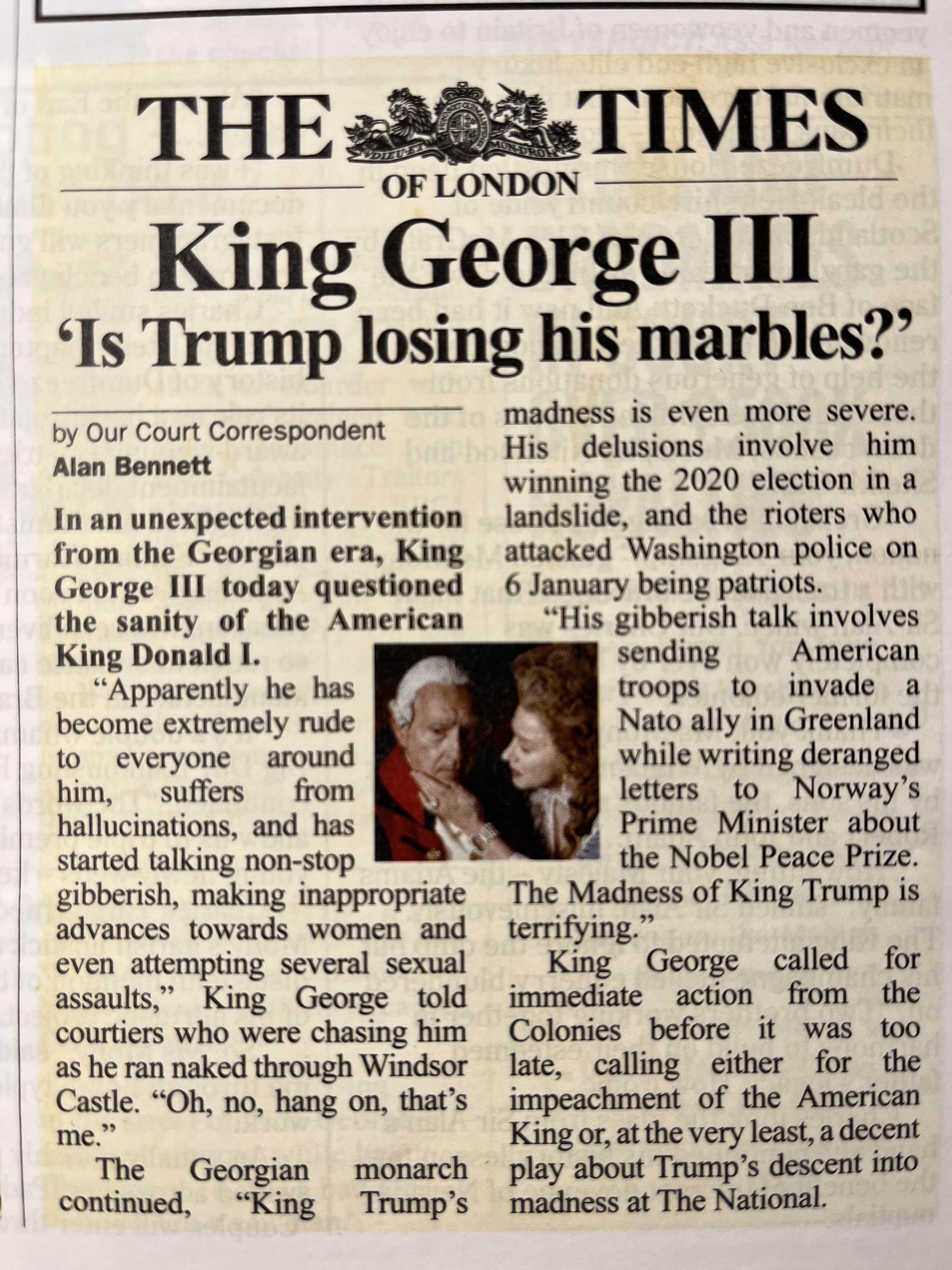
After this week of Trump craziness over Greenland, I thought I would reflect on different interpretations of his behaviour. Then I remembered I'd written about this a year ago, at the very beginning of his presidency, and, slightly to my surprise, the four dimensions (PTIB) essentially seem the same today.
A year on, however, we must add that he seems to be getting even more extreme, unpredictable and unhinged, while the violence (ICE) and lies at home are getting worse and worse. Some time ago my Oxford colleague Adam Roberts called my attention to a quotation from Rousseau (responding to the Abbé St Pierre’s project for perpetual peace in Europe): ‘to be sane in a world of madmen is itself a kind of madness’. This perfectly captures one aspect of the challenge which Mark Carney addressed so well in his Davos speech: how best to act rationally when the most powerful man in the world is acting increasingly irrationally?
4 DIMENSIONS OF TRUMPERY (first published week ending 9 February 2025)
There’s an amusing short story by Adam Mars-Jones in which The Queen (Elisabeth II, that is) gets rabies and everyone around her tries to carry on as if she’s behaving normally and rationally. Her Majesty is just being a little eccentric, you know.
I kept thinking of that novel this week as president Donald Trump made ever more outlandish proposals – ethnically cleansed Gaza as US-owned Riviera, for example – and everyone tried to make some sense of it. Me too.
Here are four dimensions of Trumpery. They are not mutually exclusive. There may be elements of each in every proposal.
Performative. Signing all those executive orders, making all those announcements, is a performance of strength, decisive action and fundamental change – even if half of it ends up going nowhere. It gives people the feeling that a lot is changing. One of the keys to the success of populists is that they understand that passion is as important as reason in voters’ reactions. He’s also ‘flooding the zone’, hogging all the attention (the new currency of our time) and keeping everyone else on the back foot. (Ezra Klein is very good on this in analysing the first few weeks of Trump’s presidency.)
Transactional. The ‘art of the deal’. You make outrageous initial demands and then settle for much less. Still, you’ve maybe achieved more than you might have with a more reasonable initial demand. An example would seem to be his recent deal with Mexico, after first imposing and then suspending a 25% tariff.
Imperial. This is an aspect that has emerged more strongly since the inauguration, with the territorial claims on Greenland, Canada and the Panama Canal. A return to a 19th century vision of US formal and informal empire in the western hemisphere? Perhaps a spheres of influence world, with Russia allowed dominance in Eurasia and China in East Asia?
Batshit crazy. The Mars-Jones’ Mad Queen dimension. A 78-year-old man who has long been an egomaniac and disinhibited narcissist now thinks he was spared by God from an assassin’s bullet in order to Make America Great Again. Perhaps also to save the world? His former national security advisor John Bolton, who now seems almost moderate, says that if you plot as dots on a piece of paper all the things that Trump does or proposes there is simply no way to join up the dots into a coherent pattern. But that’s exactly what both his supporters and his critics keep trying to do - to discern some ‘method in his madness’. (If you got Chat GPT Pro to do a search for uses of that phrase in relation to Trump, I bet the frequency would have increased in the last fortnight.)
This is not to say that it’s all madness and no method. Not at all. The man has a remarkable political instinct, and some things he definitely wants to do. Rather, the question to ask of each Trumpery move is: what’s the mix of these four elements in it?
Call it the PTIB test.
Thanks to a tip-off from a friend, I've silently corrected the first sentence to read ‘short story’ rather than ‘novel’ by Adam Mars-Jones. The story is called ‘Hoosh-Mi’ and appears in his 1977 collection Lantern Lecture.


I looked up George III. Gave about half his income to charity, provided massive support to the arts, when two mentally challenged people tried to assassinate him he treated them with compassion, he contributed a considerable sum to support victims of a fire in Montreal.
Donald Trump………
Thank you as ever.
Your footnote explains the now more obvious (remaining in the second paragraph in contrast to the first) reference to the Mars-Jones 'novel'. Just in case you wish to change that too and avoid the slight disconcertion.
JM